Disposable Camera vs QR Code Photos: Costs
Discover the true cost of disposable cameras at weddings vs modern QR code photo sharing. Compare quality, budget, and environmental impact for your big day.
By Sean · · 13 min read
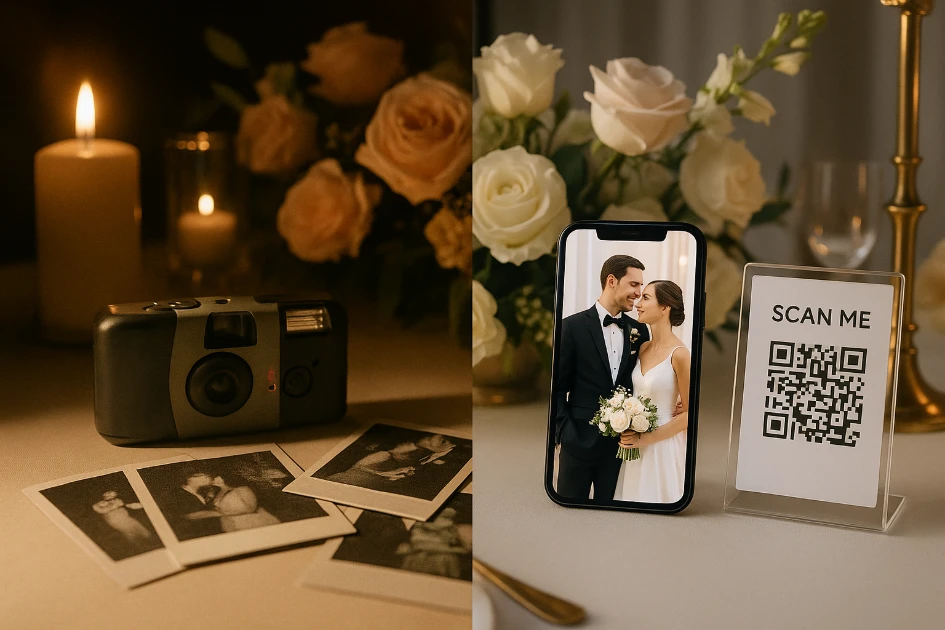
Picture this: You're planning your dream wedding, and you want every candid moment captured—not just the professional shots, but those spontaneous, joyful, unfiltered memories your guests will witness. The Pinterest boards are full of charming photos showing disposable cameras nestled between centerpieces, promising an authentic, vintage vibe that feels effortlessly romantic.
But here's what those aesthetic inspiration posts don't tell you: the hidden costs, quality risks, and logistical headaches that come with those nostalgic yellow cameras. In 2025, there's a smarter way to capture candid wedding moments that preserves the spontaneity you crave without the vintage price tag or grainy disappointments.
The Nostalgic Appeal: Why Couples Still Love the "Disposable Camera Aesthetic"
Let's be honest—disposable cameras tap into something powerful. They represent a time when photography felt less curated, more authentic. There's an undeniable charm to the idea of your guests snapping away without filters, without endless retakes, without that pressure to achieve Instagram perfection.
The psychology is simple: disposable cameras create an "unplugged" feeling. They signal to guests: "Just capture the moment, don't overthink it." And in a world where we're drowning in perfectly edited photos, that raw, unfiltered quality feels refreshing. It's the same reason film photography has made such a strong comeback among millennials and Gen Z—it feels real.
But what if you could capture that same candid energy, that same spontaneous spirit, without sacrificing photo quality or breaking your budget? That's exactly what modern QR code photo sharing solutions offer—and the comparison isn't even close.
The Hidden Costs of Disposable Cameras: A Budget Reality Check
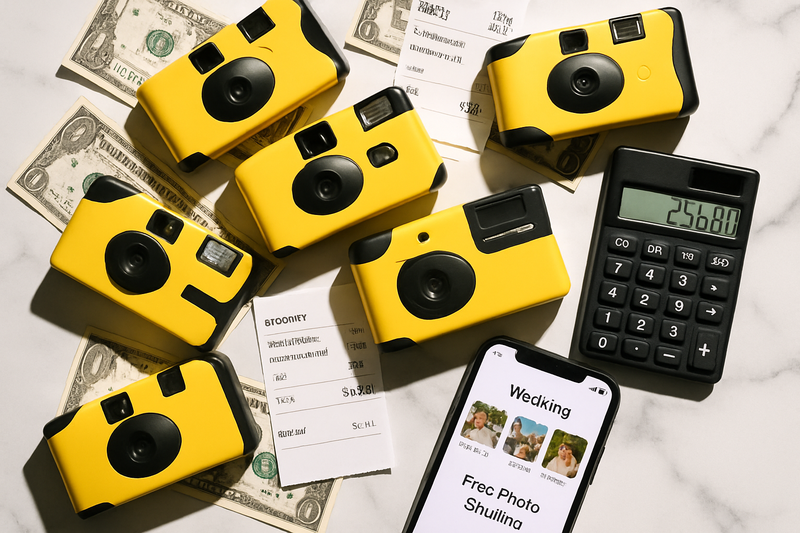
Most couples initially fall for disposable cameras because they seem inexpensive. A pack of 10 cameras costs around $150-$200 from major retailers. For a 150-person wedding with 15 reception tables, that's just $225-$300, right? Not quite.
The Real Math: What Disposable Cameras Actually Cost
Initial Camera Purchase: 15 disposable cameras at $15-$20 each = $225-$300
Film Development: Each camera requires development at $15-$22 per camera = $225-$330
Digital Scans: Most labs charge an additional $5-$10 per camera for digital files = $75-$150
Prints (Optional): If you want physical copies, add another $10-$15 per camera = $150-$225
Lost/Stolen Cameras: Conservatively 2-3 cameras disappear at every event = $40-$60 wasted
Total Real Cost: $715-$1,065 for 15 cameras
Modern QR Code Solution: $0-$49/year for unlimited photos from unlimited guests
That's not counting your time. After your honeymoon, you'll need to collect all the cameras (assuming they haven't walked away with guests), drive them to a photo lab, wait 1-2 weeks for development, then sort through hundreds of photos—many of which will be unusable.
Compare this to a modern digital photo sharing platform like Guest Clicks, where guests simply scan a QR code with their existing smartphone cameras. No additional equipment to buy, no development costs, and all photos are instantly available in the cloud. For many couples, this represents savings of $700+ while actually improving photo quality.
The Quality Gap: iPhone Sensors vs. Plastic Lenses
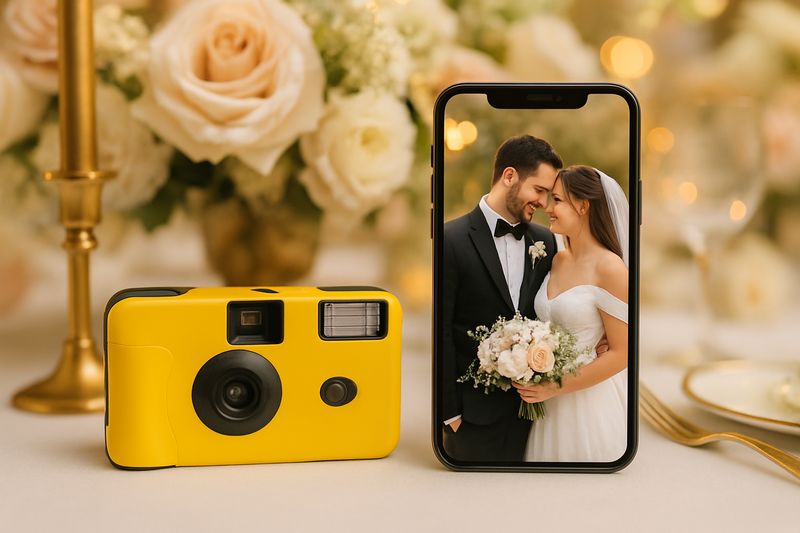
Here's an uncomfortable truth that the "vintage vibes" Instagram posts won't tell you: disposable cameras were never designed to produce high-quality images. They were engineered to be cheap, simple, and functional for bright outdoor conditions. Your dimly-lit wedding reception? That's their worst nightmare.
The Technical Reality: A disposable camera uses a simple plastic lens with a fixed aperture of f/8 to f/11 and a shutter speed of 1/100th of a second. It has no light metering, no autofocus, and relies entirely on the narrow latitude of cheap film to "hopefully" capture something usable.
Meanwhile, even a mid-range smartphone in 2025 features computational photography that would have seemed like science fiction a decade ago. According to DXOMARK's comprehensive testing, modern flagship smartphones can capture images with dynamic range, color accuracy, and low-light performance that exceeds many dedicated cameras from just five years ago.
What This Means for Your Wedding Photos
Low Light Performance: Wedding receptions typically feature mood lighting—candles, string lights, warm amber glows. Disposable cameras are notorious for producing nearly black images in these conditions because their fixed flash only reaches 4-6 feet. Modern smartphone cameras, however, use computational photography techniques like Night Mode, combining multiple exposures to create bright, detailed photos even in challenging lighting.
Detail and Sharpness: The plastic lens on a disposable camera creates soft, often blurry images—especially at the edges. Smartphone cameras use multi-element glass lenses with aspherical designs to maintain sharpness across the entire frame. Your guests' phone cameras can capture the intricate details of your dress, the delicate florals, the expressions on faces across the room.
Color Accuracy: Disposable camera film varies wildly in color rendering, especially under mixed lighting (tungsten chandeliers + LED uplighting + natural window light). Smartphone cameras automatically white-balance for accurate, true-to-life colors that match what your eyes saw.
The Unusable Factor: Wedding photographers and couples who've used disposable cameras report that 40-60% of disposable camera photos are completely unusable—too dark, out of focus, overexposed, or featuring accidental pocket shots. With smartphone photos, that number drops to under 10%, and you can see and delete bad shots immediately.
The Risk Factor: Lost Cameras, Inappropriate Photos, and Murphy's Law
Every wedding planner has horror stories about disposable cameras. Here are the most common disasters:
The "Lost Camera" Nightmare
You placed 20 cameras around your reception. At the end of the night, you collect 14. Where did the other 6 go? A guest took one home as a souvenir. Another fell behind a table. One ended up in a coat pocket by accident. Each missing camera represents $40-$50 in wasted costs and potentially dozens of lost memories.
With QR code photo sharing, there's nothing physical to lose. The "camera" lives in your guests' pockets, and every photo is automatically backed up to the cloud the moment it's taken.
The "Inappropriate Content" Reality
Wedding photographers are remarkably candid about this: nearly every wedding with disposable cameras includes at least a few photos you absolutely won't want in your wedding album. Whether it's a drunk groomsman taking bathroom selfies or guests capturing "creative" angles of themselves, you have zero control until after you've paid for development.
Modern photo sharing platforms include content moderation features. You can review photos before they're added to the public gallery, giving you control over what memories make the final cut while still preserving the candid spirit.
How to Recreate the "Candid Feel" Digitally
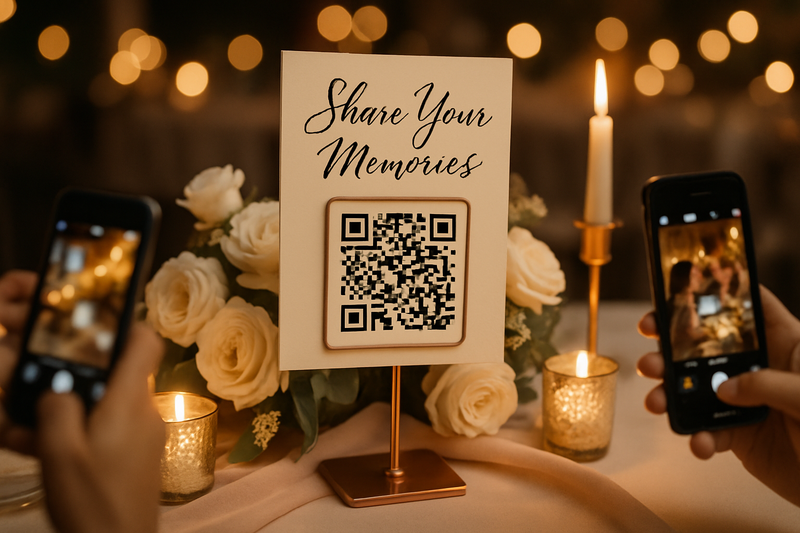
Here's the secret: the magic of disposable cameras was never about the plastic camera itself—it was about the psychology it created. The permission it gave guests to just shoot spontaneously without overthinking. The good news? You can create that exact same feeling with digital tools.
Strategy #1: Design Beautiful, On-Brand QR Code Displays
Instead of cheap yellow cameras, create elegant table cards or signage featuring your wedding QR code. Use your wedding colors, calligraphy fonts, and romantic language: "Capture this moment," "Share your view of our love story," or "Help us remember tonight forever." Make the QR code feel like an intentional part of your wedding aesthetic, not an afterthought.
Place these displays strategically—on reception tables, near the bar, at the photo booth, by the dance floor. The easier it is for guests to find and scan, the more photos you'll receive. Learn more about strategic placement techniques for maximum guest participation.
Strategy #2: Encourage "No Filter, No Editing" Uploads
Want that raw, authentic disposable camera feel? Your signage can request it: "Share your unfiltered moments" or "No editing needed—we want to see it through your eyes." Guests using their phone cameras will naturally shoot in the moment without overthinking composition or lighting, giving you that spontaneous quality you're seeking.
Strategy #3: Set Expectations at Your Ceremony or Cocktail Hour
Have your DJ or MC make a quick announcement: "The bride and groom would love to see your perspective of tonight! Simply scan the QR code on your tables to instantly share photos. No app downloads, no hassle—just point, shoot, and upload." This takes 15 seconds and dramatically increases participation.
Pro Tip: Some couples create a slideshow display showing photos as they're uploaded in real-time. This turns photo sharing into entertainment, encouraging more guests to participate and creating a fun, interactive element at your reception.
The Environmental Factor You Might Not Have Considered
If sustainability matters to you—and for many modern couples, it does—disposable cameras carry a significant environmental burden. While manufacturers claim these cameras are "recyclable," independent investigations have found that most disposable cameras still end up in landfills, especially when consumers don't return them to specific photo labs that participate in recycling programs.
Each disposable camera contains:
- A plastic body (typically high-impact polystyrene)
- A plastic lens and viewfinder
- Electronic flash components (when applicable)
- A battery (often containing heavy metals)
- Film cartridge and chemicals
Even when properly recycled, the process uses significant energy and produces waste. And the film development process? It involves chemical baths that must be carefully disposed of to avoid environmental contamination.
Digital photo sharing, by contrast, uses infrastructure that already exists (your guests' phones, cloud storage) with minimal additional environmental impact. For couples planning eco-conscious weddings, this alone might tip the scales.
When Disposable Cameras Might Still Make Sense
To be fair, there are limited scenarios where disposable cameras could work:
- Tiny micro-weddings: If you're having 20 guests or fewer and can closely monitor 2-3 cameras, the cost and risk factors are minimized.
- Outdoor daytime events: If your entire wedding takes place in bright natural light (garden ceremony and lunch reception), disposable cameras can produce acceptable results.
- Hybrid approach: Some couples use disposable cameras as decorative table favors that guests can take home, while relying on a digital solution for actual photo collection.
- Intentionally off-grid weddings: If your venue truly has zero cell service (rare in 2025), disposables might be your only option—though even then, many modern solutions offer offline upload features.
For everyone else—which is the vast majority of couples—the case for going digital is overwhelming.
Making the Switch: A Simple Implementation Guide
Ready to embrace the smarter alternative? Here's your step-by-step implementation plan:
Step 1: Choose Your Platform (3 Minutes)
Select a wedding photo sharing platform that offers QR code generation, cloud storage, and easy guest access. Guest Clicks offers all these features with a free tier that works perfectly for most weddings—no app downloads required for your guests, just instant browser-based uploads.
Step 2: Design Your QR Code Displays (30 Minutes)
Create table cards, signs, or other displays featuring your unique QR code. Most platforms provide customizable templates, or you can design your own in Canva matching your wedding theme. Print these on cardstock or have them professionally printed with your other wedding stationery.
Step 3: Test Before the Wedding (5 Minutes)
Ask a few friends or family members to test the upload process on their phones (both iPhone and Android). Make sure the experience is smooth and intuitive. Check how photos appear in your gallery and familiarize yourself with any moderation tools.
Step 4: Strategic Placement at Your Venue (10 Minutes)
On wedding day, place your QR code displays in high-traffic areas: reception tables, bar area, bathroom mirrors, photo booth, entrance, and near the dance floor. The more visible, the better the participation rate.
Step 5: Make a Quick Announcement (1 Minute)
Have your MC or DJ mention the photo sharing during announcements: "Help [Couple Names] capture tonight from your perspective! Just scan the QR code on your tables—it takes 5 seconds and requires no app downloads."
Total setup time: Less than one hour. Total cost: $0-$49 for the year. Photos received: Potentially hundreds of high-quality, instantly accessible images.
Real Couples, Real Results
"We almost went with disposable cameras for the 'vintage vibe,' but our wedding planner showed us the math. We saved over $800 by using Guest Clicks instead, and we got 347 photos from our 120 guests—way more than we ever would have gotten from disposable cameras. Plus, we could see the photos coming in during our reception, which was so fun!"
— Sarah & Michael, married October 2024
"I'm a photographer professionally, so I was skeptical of phone cameras at first. But honestly? Some of the best, most emotional photos from our wedding came from our guests' iPhones. The quality was stunning, and we got angles and moments my official photographer never could have captured."
— Jessica R., married June 2024
The Bottom Line: Get the Vibe Without the Vintage Headache
The appeal of disposable cameras is entirely psychological—and that psychology can be replicated (and improved upon) with modern tools. You can create the same "unplugged," spontaneous, authentic photo-capturing experience without:
- Spending $700-$1,000 on cameras and development
- Accepting poor image quality and unusable photos
- Risking lost cameras and inappropriate content
- Waiting weeks to see your photos
- Contributing to environmental waste
- Spending hours collecting and organizing cameras post-wedding
Modern QR code photo sharing platforms give you everything you loved about the disposable camera idea—candid moments, guest participation, authentic memories—while solving every single problem they created. Your guests already have the world's best cameras in their pockets. Why not put them to use?
If you're looking for a solution that combines the spontaneity of disposable cameras with the quality and convenience of modern technology, explore how Guest Clicks can transform your wedding photo collection. Start with our free tier to test it out—you can always upgrade if you need advanced features like Google Photos integration or unlimited events.
Looking for more ways to modernize your wedding photo strategy? Check out our comprehensive guides on digital wedding guest book alternatives that actually deliver results, without the vintage price tag.
Frequently Asked Questions
Are disposable cameras worth it for weddings in 2025?
For most couples, disposable cameras are not worth the investment in 2025. When you factor in the cost of cameras ($15-$20 each), development ($15-$22 per camera), digital scans ($5-$10), and the high percentage of unusable photos (40-60%), you're spending $40-$50 per camera for mediocre results. Modern smartphone cameras produce significantly higher quality images at a fraction of the cost, and QR code photo sharing platforms offer unlimited photo collection with no development fees.
How can I get the "disposable camera aesthetic" without using actual disposable cameras?
You can recreate the authentic, candid feel of disposable cameras digitally by using QR code displays with messaging that encourages spontaneous, unfiltered uploads ("Share your unfiltered moments"). Some photo sharing platforms even offer vintage filters that can be applied to digital uploads, giving you the nostalgic aesthetic without the quality sacrifice. The key is creating the same psychological permission for guests to shoot freely without overthinking.
What happens if guests forget to upload their wedding photos?
With QR code photo sharing, uploads happen in real-time during your event—guests scan the code and immediately share photos while they're still at your wedding. This dramatically reduces the "I forgot" problem common with asking guests to email or text photos later. Many platforms also send reminder notifications and allow post-event uploads via shareable links, giving you multiple opportunities to collect memories. Compare this to disposable cameras, where lost or forgotten cameras mean permanently lost photos.